We built the clinic into a brand. Then the ad money worked harder.
The brand came first: the site, the films, the posts patients see long before an ad. June to July is what the ad money did once that was in place, matched patient by patient, for one doctor-owned medical aesthetic clinic in Singapore. Months appear as the clinic approves them.
June to July: revenue from ads more than doubled, S$33,828 to S$76,863. Ad spend rose, S$3,984 to S$4,637.
S$4,637
Meta ad spend, July 2026: S$4,637. Akros fees excluded.
S$76,863
paid by 22 patients, matched to the enquiry that brought them, July 2026.
148
tracked enquiries, July 2026, each one carrying the ad, search or post that sent it.
Most clinic ads buy one lead, then forget it. I do it the other way: build a name people trust before they reach out, then track every enquiry back to the ad that made it.
Nine chapters, in the order a doctor would read them: the diagnosis, the treatment, the follow-up. Numbers first, then the proof behind each one.
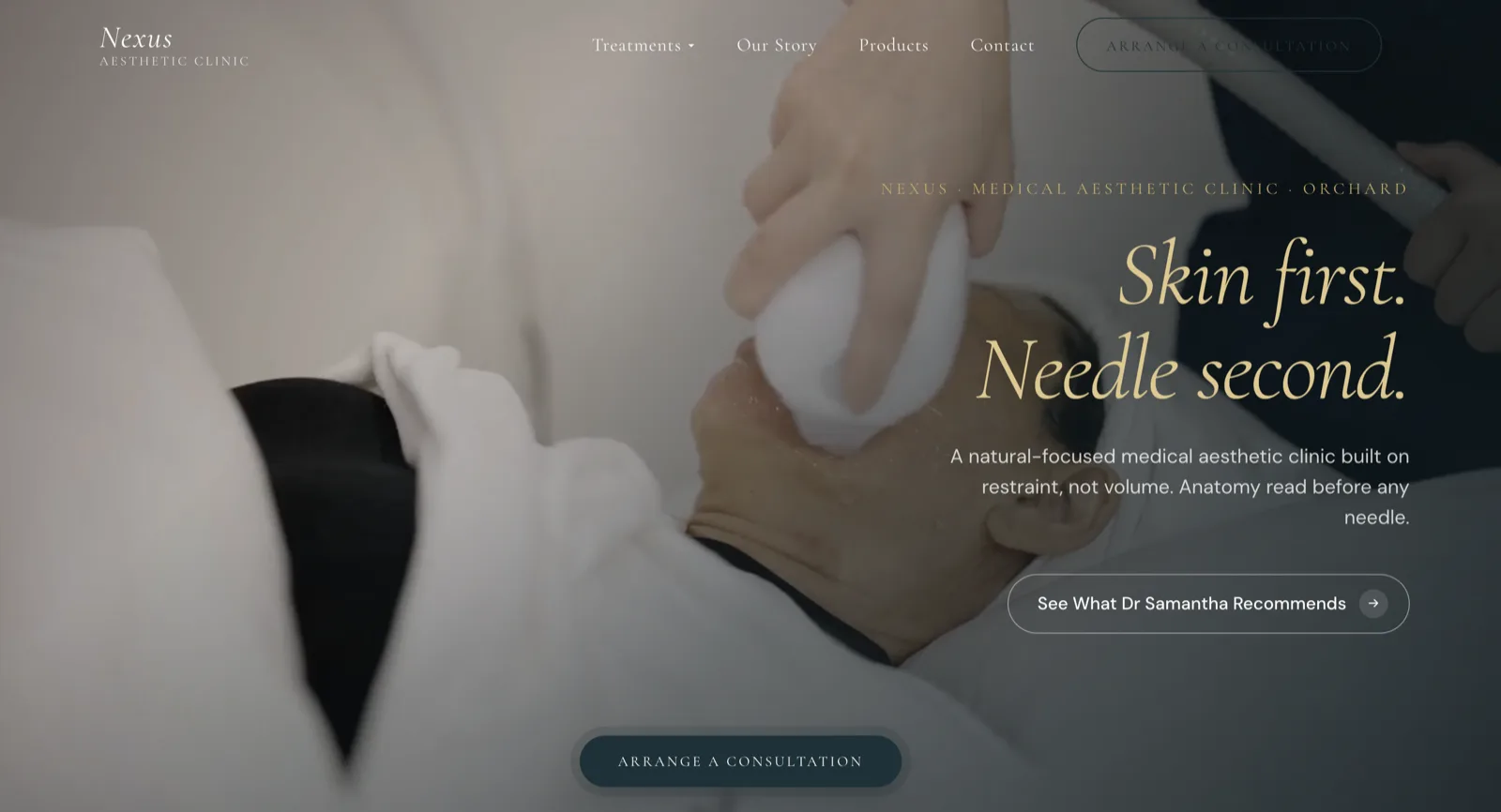
The site we built

What I built
Not six tools. One system that ends at the sale.
Most agencies hand a clinic a list of services and a pile of leads. I built Nexus a single engine instead: brand, website, search, ads, short video, a WhatsApp agent, and tracking that follows each patient past the click to the payment.
The call that mattered was where the budget went: out of search, where patients compare prices, into Meta, where the clinic’s own videos do the convincing. Cost per enquiry fell from about $222, on Google Ads alone, to about $34.
Diagnosis · Treatment, or brand
Medical aesthetic clinic marketing asks one thing first. Market a treatment, or build a brand?
Here is the whole idea in one example. Most clinics market the treatment. I market the clinic.
Google ad: “Pico Laser Treatment, Singapore”
- Bidding on the exact same keyword as every other clinic.
- The patient lines you up against twenty others and compares on price.
- Pico is pico. There is nothing to choose between you but cost.
- The day you stop paying, the leads stop. You rent a commodity.
What we build
Nexus: natural-looking, conservative aesthetics, with Dr Samantha
- Patients come for the name and the doctor, not the cheapest laser.
- You own a theme, natural-looking and conservative, across the whole skin-booster range, not one machine.
- Trust is built before they enquire, so they choose you on purpose.
- The value sits with the clinic and Dr Samantha, and it compounds.
Same pico laser. Completely different business. One is a price war you rent. The other is a brand you own.
The question most owners cannot answer
Right now, can you name the exact ad that produced your last patient enquiry? The channel, the campaign, the creative, and what that patient went on to actually pay?
When that enquiry lands at 11pm, does someone answer in seconds, before they message three other clinics? Does your team turn the happy patients into Google reviews, week after week, without anyone chasing? And when a patient asks an AI for a clinic, does your name even come up?
Most owners can’t answer even one of these for sure. Marketing gets left as a black box. Money goes in. Some leads come out. Nobody can say which dollar did the work, how fast it was answered, or where the patient really came from. That isn’t your fault. A black box is easier to sell than a number you can check.
For Nexus, these stop being guesses. I can name the source of every enquiry, down to the exact ad, and see if it booked. The same system replies in seconds and runs the day-to-day. And the brand is starting to be the name patients and AI both reach for. That is the whole point. A clinic you can hold to a number, end to end.
In practiceThe channel your patients actually come from is often nothing like what you would guess, and you only find out by tracking every single one.
Diagnosis · Every enquiry carries its source
Every lead is gated and tracked to its exact source.
Every enquiry passes through a gated form before it reaches the clinic. No lead is anonymous. For each one I can see the true source. Meta, SEO, or search. Which campaign. Which exact ad.
From 11 May to 15 June, I tracked roughly a hundred enquiries this way, each one tagged to where it came from. That is a five-week window, not a single month. Because the tracking is this complete, I put money where real enquiries come from instead of guessing. This is the boring plumbing that makes everything above honest. It is also the part that almost never gets built.
Floor not ceiling
And these are only the leads the system could track. Patients who called, messaged WhatsApp, or walked in after finding the clinic on Google Maps were not counted here. The real number is higher. What you see is the floor, not the ceiling.
3 tracked enquiries came from Google Ads
Against roughly 100 from Meta in the same five-week window. That is exactly why I cut its spend.
How I track which channel every patient came from is where the numbers on this page come from, and it runs inside the patient acquisition system.
Treatment · Search sends enquiries
Search now sends enquiries, not just clicks.
Before, Nexus was almost invisible in search for the treatments that matter. You can’t build a brand on that. So search became its own channel, counted the same way as every ad: by the enquiry it brings, never the click or the impression.
Nexus now sits on Google’s first page for 126 treatment searches in Singapore. That is the shelf. The enquiry is what gets counted.
treatment searches with Nexus on Google’s first page. Measured in Google Search Console, 2026.
of the 148 tracked enquiries in July 2026 came in with no ad behind them. Nobody paid for those clicks.
Here is the honest part. This didn’t spike the leads. Most enquiries still come from Meta.
What it proves is just as important. The base is set for Nexus to own these searches as the brand grows. Ads win this month. Search pays back over a longer horizon, and a page that ranks costs nothing per click.
In practiceSearch can reach page one fast. It won’t replace your ad leads yet, but it is the compounding layer that makes every future lead cheaper.
Treatment · The budget followed the patients
The Google Ads budget moved to where the patients were, and each enquiry cost less.
Here is the part you rarely get shown. In April, when almost all the spend was Google Ads, a lead cost about $222. That comes straight from the Google Ads data, not a guess. By June the budget had moved from Google Ads to Meta, and the brand and SEO did more of the work. A real form-filled lead then cost about $34.
Gated means they actually filled in a form. Not a click. Not a view. A real enquiry. In the first three weeks of tracking, 11 to 31 May, that was about 82 real leads. The cost kept falling from there.
The brand compounds because growing the Instagram following fast was on purpose. A follower count is trust you can see. More trust means patients are quicker to enquire, and you pay less to win them. So I also run low-cost brand ads that put the clinic in front of the right people, and the name makes every future lead cheaper.
Verified data
What it cost to win one lead, falling as the budget moved to Meta and the brand took over.
That is the whole point. This isn’t about spending less. It is about moving every dollar to where it pays back the most. The same budget then does far more, so you can grow, instead of paying more for the same result.
In practiceCost per lead should fall over time on its own, because the brand is doing the selling. If it is flat, nothing is being built.
In practiceI count the people who actually filled in a form, and I made each one cheaper while cutting paid search. That is return, not vanity.
Treatment · Operations that answer themselves
The operations run themselves.
When someone asks about a price or leaves a comment, the system replies, saves the lead, and moves the chat to the clinic’s own channel on its own. The patient gets a fast reply. The clinic gets a real, tracked lead instead of a comment that vanishes, plus a staff alert with a suggested reply in seconds.
Under the hood it is a system I built, not an off-the-shelf inbox tool. It starts on the social side, then my own system takes over. It saves the lead, sorts it by how urgent it is, and alerts the team. No outside tool sits in the middle, so the clinic keeps its own data and its own number. The team stops watching the inbox, and no enquiry slips through after hours.
A comment or price question comes in
Auto-reply captures and routes it
Staff get an alert, lead is tracked
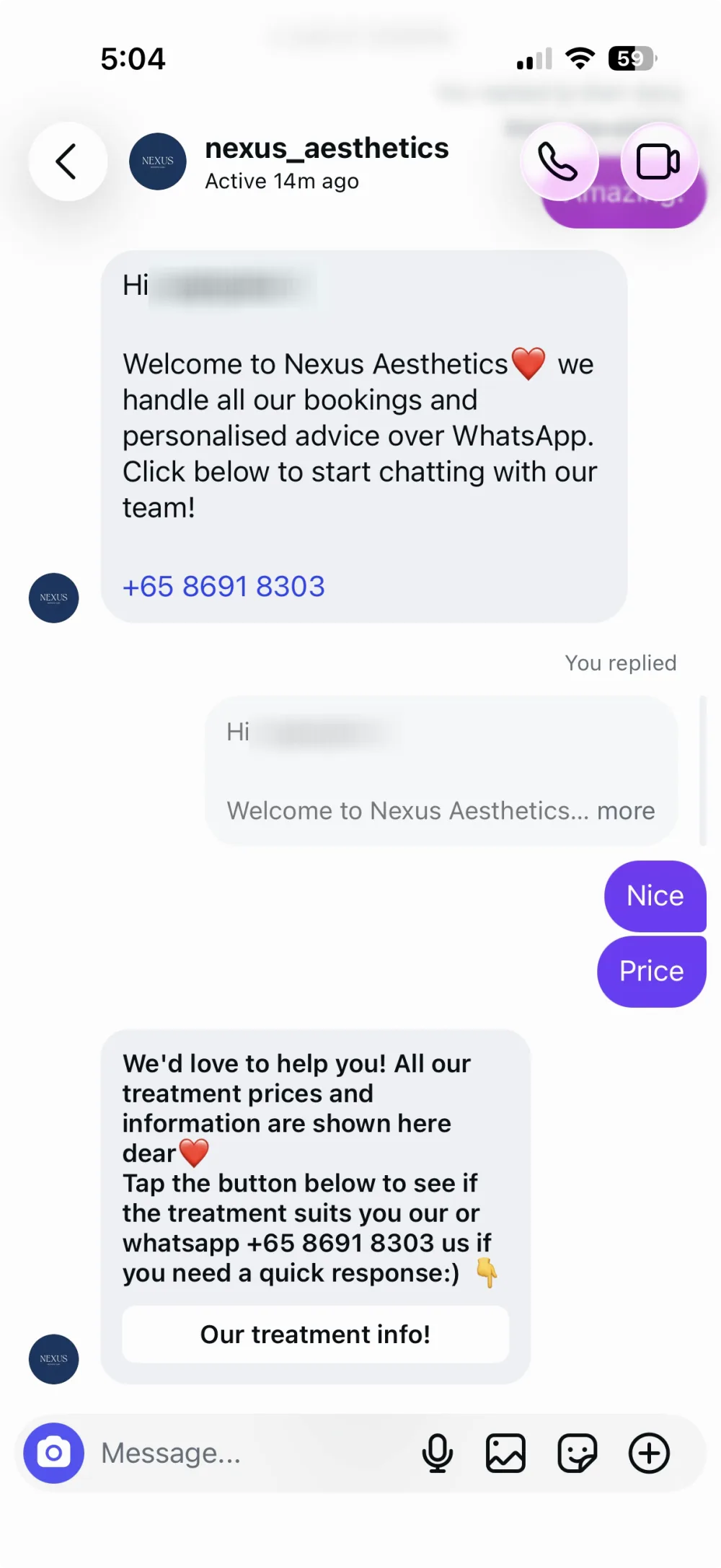
A comment is caught and routed automatically, no one watching the inbox.
Illustrative exchange. No real patient data.
The AI agent replies, captures the lead, and alerts the clinic’s team.
Treatment · When patients ask AI
When patients ask AI instead of Google.
Search is changing. More patients now ask AI assistants for a clinic instead of scrolling Google. Most clinics are invisible to those answers, because their marketing was never built for it.
This is why the theme matters. I didn’t try to make Nexus show up for everything. I built it around one clear idea: natural-looking, conservative medical aesthetics. So patients and AI both come to know the clinic for that one thing. When you are known for a theme, you become the name an AI repeats when someone asks.
citations in Google’s AI Overviews, 44 of them new at the second measurement. When someone asks Google’s AI, Nexus is part of the answer.
Gemini
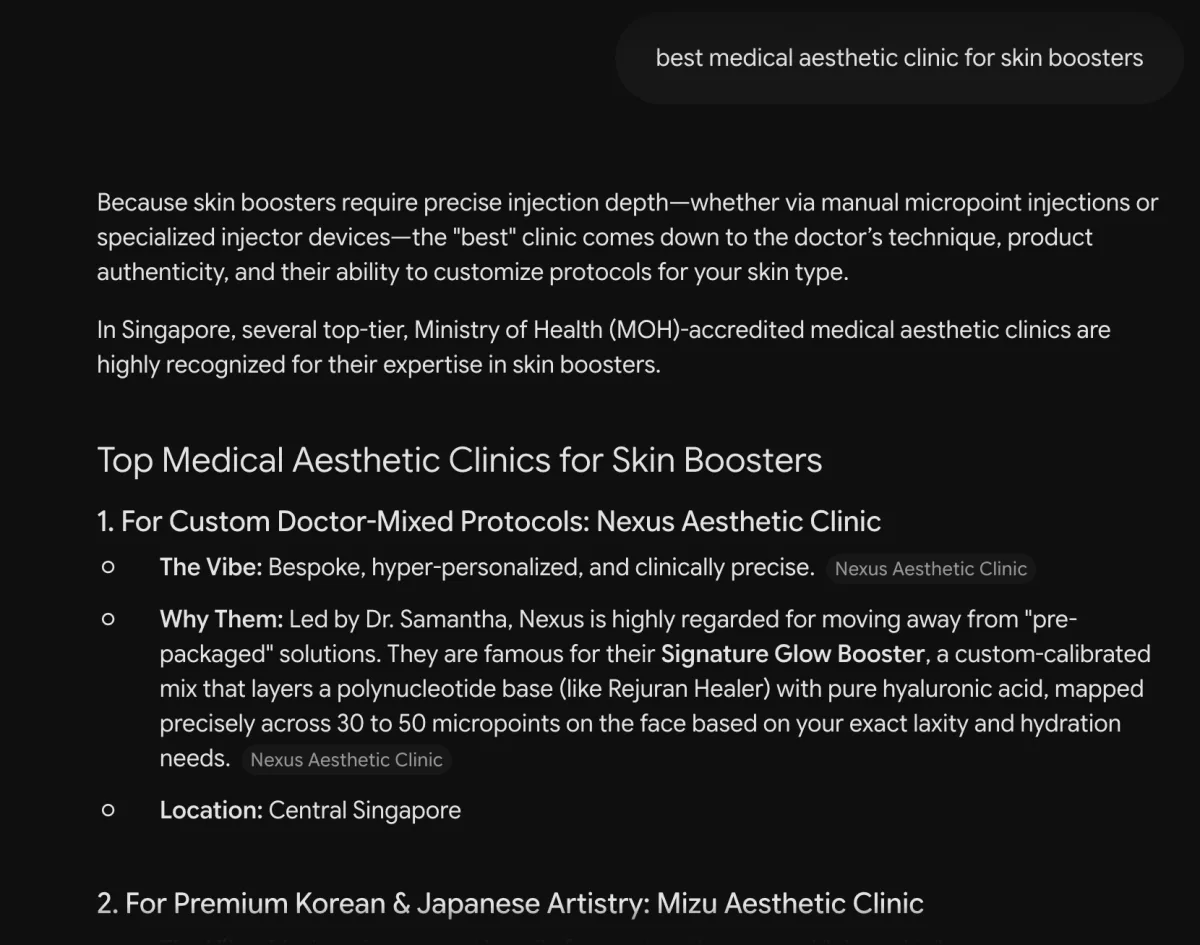
Asked for an aesthetics clinic in Singapore, names Nexus. A captured, dated proof, not a live test (AI answers vary day to day).
ChatGPT
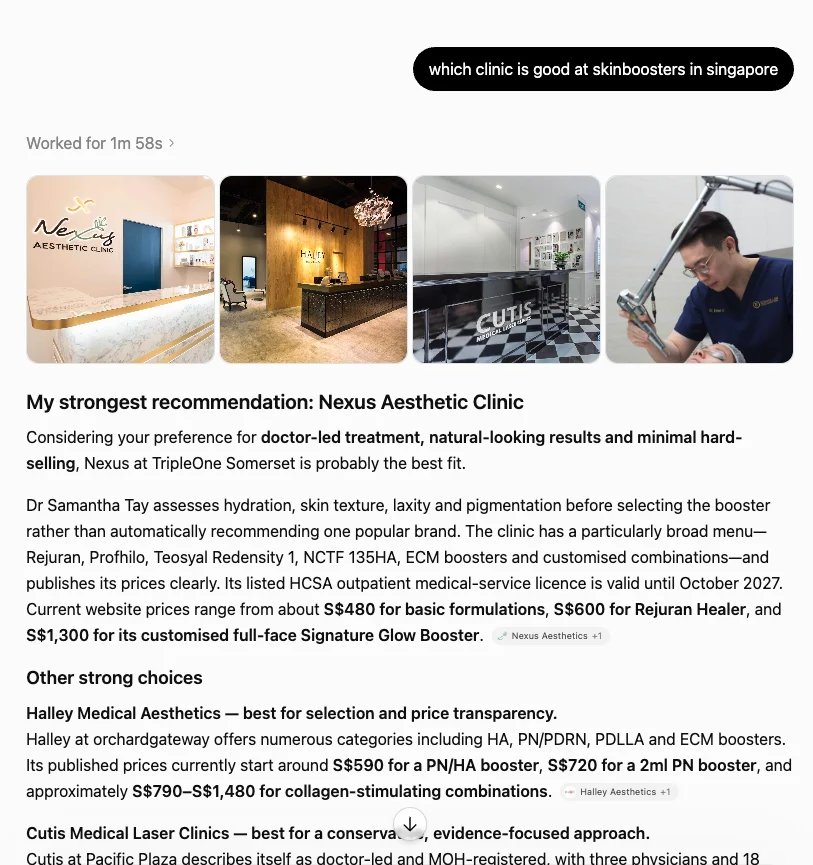
Asked which clinic is good at skin boosters in Singapore, it leads with Nexus. Captured and dated, not a live test.
Google Analytics
More than double, one month to the next. Two 30-day windows. This counts only what Google Analytics can trace back to ChatGPT, so the real number is at least this.
In practiceThe top of Google matters less every year. The real race is being the name patients and AI both already trust for one specific thing.
Follow-up · How the money number is made
How the money number is made.
Everything above this line is a lead, a ranking, or a cost. This one is money in the bank. In July 2026 the clinic spent S$4,637 on ads. The patients those ads brought in paid S$76,863 in the same month.
S$4,637
Meta ad spend, July 2026: S$4,637. Akros fees excluded.
S$76,863
paid by 22 patients, matched to the enquiry that brought them, July 2026.
148
tracked enquiries, July 2026, each one carrying the ad, search or post that sent it.
16.5x
paid back for every dollar of Meta ad spend that month.
Here is how I know, and it is the whole reason I build the tracking first. Every enquiry carries its source all the way through to the clinic’s own booking and billing system. A patient only counts once an invoice is actually paid. I never count what an ad platform claims it did.
- Meta Ads spend by day (meta_ad_metrics). Media only, Akros fees excluded. Google Ads spend by day (ad_metrics). Media only, Akros fees excluded. Zero rows reads as null, never as zero, until a human confirms the account was paused.
- A patient counts when the clinic's own billing shows an invoice, matched to the enquiry that brought them, and only once however many times they enquired. One patient counted once: phone last-8 match first (including a phone typed into the name field), then normalised name.
- Tracked enquiries only: a gated form handed into WhatsApp with its source attached, or a conversation started from a tracked link. Meta, Google and organic search. Junk and test rows excluded. Phone calls, walk-ins and direct WhatsApp taps are not counted, so the figures are a floor.
In practiceCount what the patients actually paid. A lead is a promise. A paid invoice is the only number that tells a clinic whether the marketing worked.
Follow-up · Where the budget goes next
The goal is return, so your marketing scales.
01
Google search
Your highest-intent traffic, people actively looking to buy right now. But Google Ads makes you rent it, every month, forever.
02
Meta
Excellent for the brand and brings real volume, but those leads are earlier, lower-intent.
03
SEO
How you own that high-intent search instead of renting it, so once it ranks, the clicks cost you nothing.
So the plan is simple. Build the brand. Build SEO strong enough to own the searches that matter. Keep moving the budget to whatever pays back the most, instead of staying stuck in the same channels.
Nexus is already proving it. I moved spend off Google Ads, cost per lead on Google Ads fell from about $222 to about $34, SEO went from invisible to page one, and Meta keeps the brand and the volume going. That is what a system built for return looks like.
In practiceReal growth comes from moving spend to where it returns, not from spending more on what you already run.
Follow-up · This isn’t for everyone
Doctor-owned clinics. Nobody else.
I am not the right fit for every clinic, and I would rather say so up front.
A fit
- The doctor owns the clinic and answers for its name.
- Any specialty: aesthetics, surgery, general practice, women’s health, dental.
- You are in Singapore, under HCSA rules. The ad accounts and the site stay in your name.
- Groups, chains and investor-owned clinics.
- A direct competitor of a clinic I already run.
- Anyone who wants cheap leads this month, and nothing after.
TWO CLINICS PER SPECIALTY, MAXIMUM
A third is a conflict of interest.