Licensing and compliance
The 9 Ahpra advertising guidelines easiest to break by accident
Have you ever liked a patient's review? Under Ahpra's 2025 rules for cosmetic clinics, that can count as a testimonial. Here are nine easy slips.
The short version
- Since 2 September 2025, Ahpra has a separate advertising guideline for injectables, veneers, threads, PRP and other higher risk non-surgical cosmetic procedures.
- It covers clinic owners and businesses, not just registered practitioners. Anyone in control of the advertising is responsible for it.
- For a doctor or nurse, liking, re-sharing or linking to a patient's positive review counts as using a testimonial, which the National Law bans.
- The maximum fine is $60,000 per offence for a person and $120,000 for a company, in every state and territory since July 2024.
- The TGA separately bans advertising prescription-only injectables to the public, and its current FAQ no longer expressly permits generic terms like 'dermal fillers'.
Have you ever liked a happy patient's review of your clinic? If a doctor or nurse does that, the Ahpra advertising guidelines for cosmetic work count it as using a testimonial. Testimonials in ads break the National Law. The fine can reach $60,000 for a person and $120,000 for a company. That is for each offence.
That is one of nine rules I think are the easiest to break by accident. None of them are hidden. They sit in a guideline Ahpra and the National Boards put out on 2 September 2025. But most of them are about small daily habits, like sharing a story or adding a photo filter. That is why they slip past.
A note on who is writing. I'm Tyler Ang. I market doctor-owned clinics in Singapore, not Australia. Our rules are stricter in places. Here, before-and-after photos are banned outright. So I read the new Australian rules line by line to see where they land. Each rule below links back to where it came from. Read those pages before you change anything. This is a marketer's reading, not legal advice.
Who the 2025 Ahpra advertising guidelines apply to, including you
The new guideline covers "higher risk non-surgical cosmetic procedures". Ahpra's own examples include cosmetic injectables "such as botulinum toxin and dermal fillers". It also lists dental veneers, thread lifts, injection lipolysis, sclerotherapy, platelet rich plasma and hair transplants. If your clinic does any of these, the guideline is about you.
It is not just for doctors and nurses. It also covers people who are not registered, and "business, partnerships and corporate entities". The rules apply to "each person who is advertising the service". That means the owner, and anyone in control of the ads. If you own the clinic, or you run its Instagram, you are in.
| Document | Starts | Covers |
|---|---|---|
| Guidelines for advertising a regulated health service | Earlier, still in force | All health ads. The base rules. |
| Guidelines for registered medical practitioners who advertise cosmetic surgery | 1 July 2023 | Doctors who advertise cosmetic surgery |
| Guidelines for advertising higher risk non-surgical cosmetic procedures | 2 September 2025 | Anyone who advertises injectables, veneers, threads, PRP and similar |
The cosmetic surgery rules for doctors started on 1 July 2023. When the documents differ, follow the one that is most specific. For an injectables clinic, that is the 2025 one. You can read it in full on Ahpra's cosmetic advertising page.
Three Ahpra advertising guidelines you can break with one tap on your phone
The first three are about social media. They are easy to miss because nobody plans to break them. They happen in a few seconds, on a phone, between patients.
1. Liking or replying to a patient's glowing review
Section 3.5 says a practitioner has used a testimonial when the practitioner "interacts with a review". Its example is "liking or otherwise responding" to a patient's post. Linking to a good review counts too. Patients can still post reviews on review sites. The rule is about what you do with them.
The guideline even names a fix. Turn off reviews, comments or tagging on your own pages to lower the risk.
2. Re-sharing a patient's story about their result
Say a patient posts that they love the result or the practitioner. If you re-share it, that counts as a testimonial (section 3.5). Posting it to your own Stories counts too, even though Stories vanish after a day (section 3.4).
3. Letting an influencer say what you cannot
If you pay or gift an influencer, ambassador or content creator, you are responsible for what they post (section 4.2). If they rave about their own result, that is your testimonial. Ahpra adds that influencer posts are a special risk to young people. Ads for these treatments must not be aimed at anyone under 18. Social media ads must be marked as adult content (section 9.2).
Three ways your before-and-after photos can break the rules
Unlike Singapore, Australia still lets you use before-and-after photos. But the 2025 guideline sets tight rules for them. Each rule is one more way to get it wrong.
4. Showing the 'after' first, or on its own
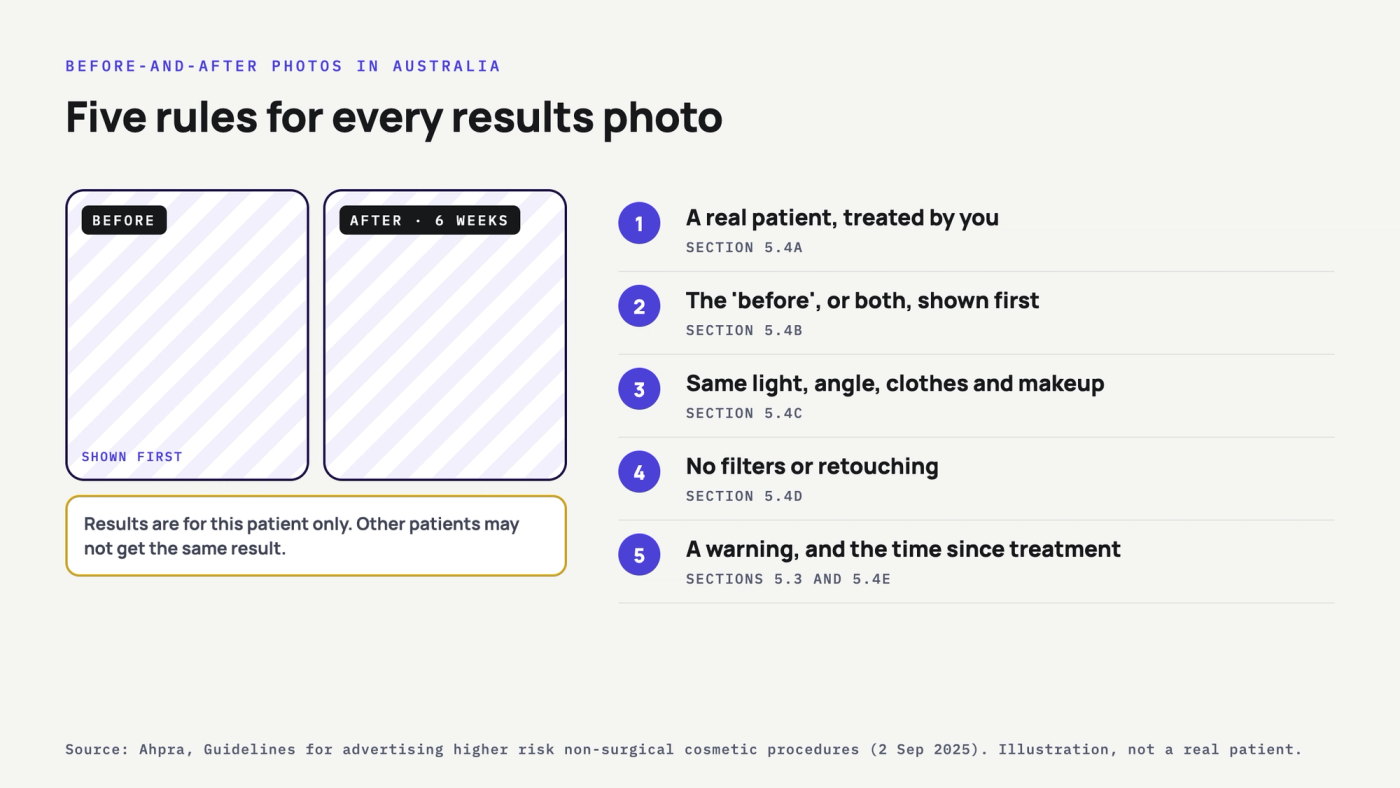
The first image people see must be the 'before', or both side by side (section 5.4b). An 'after' that leads the post may set false hopes. Both photos must show a real patient who had that treatment with that practitioner (section 5.4a).
5. A filter, a ring light, or a model who never had it
No filters, no retouching and no smoothing (section 5.4d). Light, angle, background, clothes and makeup should match in both shots (section 5.4c). Do not use a model or a star unless they really had the treatment (section 5.2). And never show anyone under 18 (section 5.5).
6. No warning and no date on the result
Any image that shows a result needs a clear warning. It must say the result is only for this patient and others may not get the same (section 5.3). The 'after' should also say how long after the treatment it was taken (section 5.4e).
There is a consent step too. You need the patient's written okay to use their photo. It must be separate from their okay for the treatment. They can take it back at any time, and then you take the photo down (section 5.8).
Two kinds of words that now count as playing down a treatment
7. 'Safe', 'quick', 'painless' and other soft words
Do not use words like "gentle", "simple", "safe", "quick" or "easy" without clear facts about risk (section 6.2). "Painless" is out, because people feel pain in different ways (section 6.6). Your ads must give real facts about healing time. Full risk facts must be easy to find. On social media, a link to that page is enough (sections 6.3 and 6.5).
8. 'Perfect pout', 'happier you', emojis and guessing games
The guideline says these habits make a serious treatment look trivial:
- phrases like "perfect pout", "happier you" or "best version of yourself" (sections 7.3 and 8.1).
- emojis on images, in replies to images, or in the ad text (section 6.7).
- music, dancing or funny montages of results (section 5.6).
- games like "guess how many mls of filler we used" (section 6.7).
- giving a treatment away as a prize (section 6.4).
- apps or filters that show how someone will look after (section 7.2).
- saying it will boost confidence or change a life, without real proof (section 8.3).
Mistake nine is not in the Ahpra advertising guidelines at all
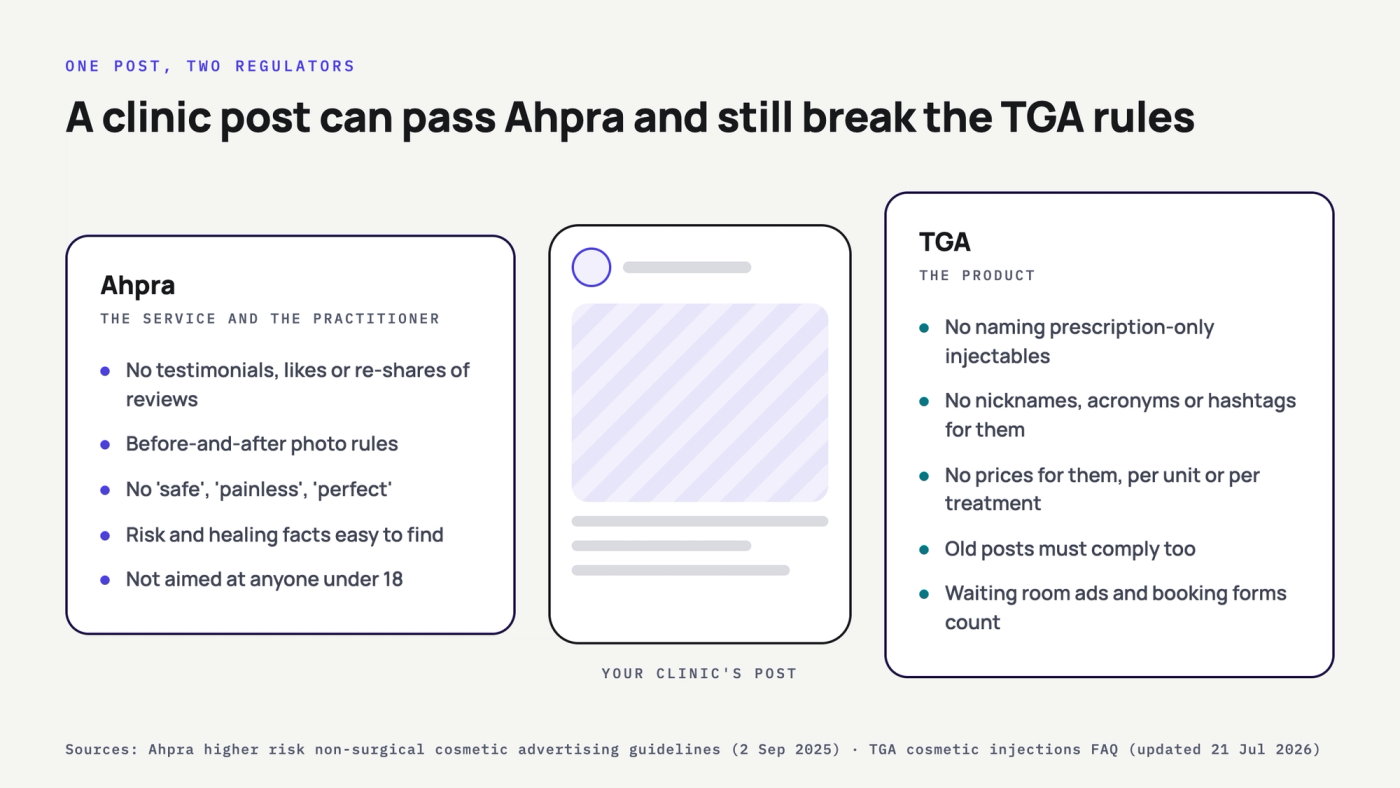
Ahpra looks after the service and the practitioner. The Therapeutic Goods Administration (TGA) looks after the product. The TGA says most cosmetic injectables hold a prescription-only (Schedule 4) substance. Those cannot be advertised to the public. So a post can break the TGA rules while it follows every Ahpra rule.
9. Naming the injectable, even in a general way
This is where I found advice online most out of date. Read the TGA's FAQ on cosmetic injections. It was last updated on 21 July 2026. It says the TGA no longer expressly permits terms like "wrinkle reducing injections" or "dermal fillers". That applies when a reader would take them as promoting a prescription-only medicine. Acronyms, nicknames and hashtags count too.
The same FAQ says a few more things most clinics will not expect:
- A price for a prescription-only injectable, per unit or per treatment, is likely to count as an ad for that product.
- Old social media posts must comply, not just new ones.
- Ads in your waiting room are likely to be caught.
- A public booking form where people pick prescription-only treatments is likely an ad.
- You are responsible for comments other people post on pages you control.
- A line that says "for education only" does not get you out of the rules.
The TGA's advice is to promote the kind of consult you offer, not the medicine.
| Product | What it is | Can it be named in public ads? |
|---|---|---|
| Profhilo | Has hyaluronic acid, a prescription-only (Schedule 4) substance | No |
| Sculptra | Has poly-L-lactic acid, also Schedule 4 | No |
| Rejuran | A Class III medical device, not Schedule 4 | Not banned by the TGA |
| PDO threads | A Class III medical device | Not banned by the TGA, if listed on the ARTG |
| Lasers, ultrasound, radio frequency | Medical devices with no Schedule 4 substance | Generally yes, under the Advertising Code |
What breaking the Ahpra advertising guidelines can cost your clinic
Ahpra's advertising and the law page sets out the numbers. Since July 2024, these higher fines apply in every state and territory. That includes Western Australia.
| Who | Top fine for each ad offence | What else can happen |
|---|---|---|
| A person, registered or not | $60,000 | Board action on registration, for a practitioner |
| A company | $120,000 | Court action |
The fine is per offence. A feed with dozens of posts can hold dozens of offences. For a practitioner, the guideline warns that serious or repeated failure "may have consequences" for their registration.
Do you work in someone else's clinic? You are not off the hook. The guideline says you must be able to show you took "all reasonably practicable steps" to get bad ads fixed.
How Singapore's rules compare, and what working under them taught me
I work under Singapore's Healthcare Services (Advertisement) Regulations 2021. For Australia, Ahpra's summary of the advertising rules sets the base, such as offers needing clear terms. Here is how the two countries line up.
| Rule | Australia | Singapore |
|---|---|---|
| Patient testimonials | Banned (National Law s133) | Banned (regulation 5(1)(f)) |
| Before-and-after photos | Allowed, under strict rules | Banned (regulation 5(1)(d)) |
| Words like 'world's best' | Seen as trivial (section 2.8) | Banned (regulation 5(1)(e)) |
| Discounts and offers | Allowed with clear terms | Restricted (regulation 15) |
I wrote up how that works for one Singapore clinic in our Nexus Aesthetic case study. I also tested whether an AI can write a clinic ad that follows the rules, in this article on Singapore's ad rules. It could not do it well, even when I gave it the full regulation.
A 15-minute check you can run on your own feed this week
You do not need a lawyer to find the clear problems. Open your clinic's Instagram, Facebook and website. Then go down this list.
| Check | Where to look | Rule |
|---|---|---|
| Any liked, shared or linked patient reviews? | Comments, Stories highlights, website | Ahpra 3.5 |
| Is the 'after' ever the first or only image? | Grid, ads, website gallery | Ahpra 5.4b |
| Does each result image have a warning and the time since treatment? | Every results post | Ahpra 5.3, 5.4e |
| Any filters, emojis, music or 'guess the mls' posts? | Reels, Stories | Ahpra 5.6, 6.7 |
| Any 'safe', 'painless', 'quick' or 'perfect' in captions? | Captions, ad text | Ahpra 6.2, 6.6, 8.1 |
| Are risk and healing facts one tap away? | Bio link, ad landing page | Ahpra 6.3, 6.5 |
| Does a named practitioner show a registration number? | Team page, ads | Ahpra 2.7 |
| Any product names, nicknames, hashtags or injectable prices? | Captions, hashtags, price list, booking form, waiting room | TGA FAQ |
If a check fails, fix the newest and most-seen posts first. Then work back. The TGA says old posts count too.
Questions cosmetic clinic owners ask about the Ahpra rules
Do the 2025 rules apply if I am not a doctor or nurse?
Yes. The guideline names people who are not registered. It also names businesses, partnerships and companies. A clinic owner who is not a practitioner is covered.
Can patients still leave Google reviews?
Yes. Section 3.7 says the ban does not stop patients posting reviews on review sites. A practitioner must not use them in ads, link to them, re-share them, or like or reply to them (section 3.5).
Can I still post before-and-after photos?
Yes, in Australia, if you follow section 5. Use a real patient. Show the 'before' or both first. Match the conditions. Do not edit. Add a warning and the time since treatment. If the result clearly comes from a prescription-only injectable, the TGA FAQ says the photo is likely an ad for that product too.
Can I put my injectable prices on my website?
The TGA FAQ says a price for a prescription-only cosmetic injectable is likely to count as an ad for that product. It says a cosmetic clinic is unlikely to fit the narrow exception for community pharmacies. Talk to an adviser before you post one.
Do old posts count?
The TGA FAQ says all social media posts, old and new, must comply. I would treat your whole feed as live for Ahpra's rules too.
None of this stops a cosmetic clinic from marketing well. It moves the weight from hype to facts. Want a second pair of eyes on your feed? Send me a message and I'll tell you what I'd fix first. You can also see how I build a patient acquisition system for clinics under strict rules, or read more about me.